Google Scholar
Featured Articles:
Wolter, J.M.*, Le, B.D.*, Matoba, N., Lafferty, M.J., Aygün, N., Liang, D., Courtney, K., Elwell, A., Piven, J., Zylka, M.J., Stein, J.“Cellular GWAS identifies common genetic variants that influence lithium induced neural progenitor proliferation.” Biological Psychiatry (2023).
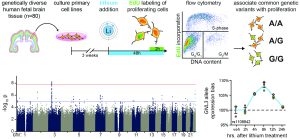
This paper describes a novel approach to investigate how common genetic variation affects human traits. We used a library of genetically diverse human neural progenitor cells to explore how genetic variation affects response to lithium – a common treatment for bipolar disorder. We used this approach to identify a single gene – GNL3 – whose expression is regulated under tight temporal control by common genetic variants, which is necessary and sufficient for lithium’s ability to induce cell division.
Commentary and Feature in Biological Psychiatry!
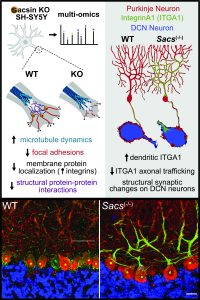 Romano, L.E.*, Aw W.Y. *, Hixson K.*, Novoselova, T.V., Havener T.M., Howell S., Hall, C.L., Nethisinghe, S., Hatimy, A., Whiteford, J.R., Thalassinos, K., Graves, L., Hickey, A., Chapple, J.P.†, Wolter, J.M.† “Multi-omic profiling reveals the ataxia protein sacsin is required for integrin trafficking and synaptic organization.” Cell Reports (2022)
This project was a collaboration between The Chapple Lab at Queen Mary University of London, the UNC Catalyst for Rare Disease, and the UNC Neuroscience Center. ARSACS is a pediatric onset neurodegenerative ataxia which is caused by mutations in poorly characterized protein Sacsin. We used several mass-spec based approaches to systematically characterize molecular changes in a cellular model of ARSACS. We identified that trafficking of synaptic adhesion proteins is affected in ARSACS cells, and that cerebellar Purkinje neurons have altered synaptic structure in the ARSACS mouse model.
Feature by UNC News!
Wolter, J.M.*, Mao, H.*, Fragola, G., Simon, J.M., Krantz, J.L., Bazick, H.O., Oztemiz, B., Stein, J.L., Zylka, M.J. “Cas9 gene therapy for Angelman syndrome traps Ube3a-ATS long non-coding RNA.” Nature (2020)
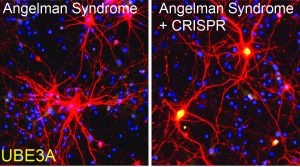
Angelman syndrome is a severe neurodevelopmental disorder caused by mutation or deletion of the maternal allele of UBE3A. The paternal allele is silenced by a long non-coding RNA (UBE3A-ATS) which is transcribed in antisense orientation to UBE3A. This creates a unique situation where, should we interfere with UBE3A-ATS, we could presumably turn on dad’s copy of UBE3A as a therapeutic strategy. To do this, we used CRISPR/Cas9 genome editing tools to block the expression of the UBE3A-ATS. When packaged into adeno-associated virus (AAV) and delivered to the brains of prenatal mice, Cas9 unsilenced the paternal allele of Ube3a and rescued many of the anatomical and behavioral deficits associated with Angelman syndrome. And because this approach uses genome editing, these effects persisted throughout the lifespan of the animals from a single treatment before birth.
Featured in Nature’s Genomic Medicine Collection and Spectrum News!
Publications:
Matoba, N.*, Le, B.D.*, Valone, J.M.*, Wolter, J.M., Mory, J., Liang, D., Aygün, N., Liang, D., Boradaway, K.A., Bond, M., Mohlke, K.L., Zylka, M.J., Love, M.I., Stein, J. “Stimulating Wnt signaling reveals context-dependent genetic effects on gene regulation in primary human neural progenitors.” Nature Neuroscience (2024)
Bazick, H.O., Mao, H., Niehaus, J.K., Wolter, J.M., Zylka, M.J. “AAV vector-derived elements integrate into Cas9-generated double strand breaks and disrupt gene transcription.” Molecular Therapy (2024)
Lafferty, M., Aygün, N., Krupa, O., Liang, D., Wolter, J.M., Geschwind, D., de la Torre-Ubieta, L., Stein, J. “MicroRNA-eQTLs in the developing human neocortex link MiR-4707-3P expression to brain size.” eLife (2023)
Xing, L., Simon, J.M., Ptacek, T.S., Yi, J.J., Loo, L., Mao, H., Wolter, J.M., McCoy, E.S, Paranjape, S.R., Taylor-Blake, B., Zylka, M.J. “Autism-linked UBE3A gain-of-function mutation causes interneuron and behavioral phenotypes when inherited maternally or paternally in mice.” Cell Reports (2023)
Santorelli, F.S, McLoughlin, H.S., Wolter, J.M., Galatolo, D., Synofzik, M., Mengel, D.*, Opal, P.*, AGI-WG2-Biomarkers study group. “Standards of Fluid Biomarker Collection and Pre-analytical Processes in Humans and Mice: Recommendations by the Ataxia Global Initiative Working Group on Biomarkers.” Cerebellum (2023)
Wolter, J.M., Jimenez, J.J., Stein, J.L., Zylka, M.J. “High-throughput ToxCast chemical library screen identifies diethanolamine as a regulator of Wnt signaling.” FASEB BioAdvances (2022)
Liang, D., Elwell, A.L., Aygün, N., Krupa, O., Wolter, J.M., Kyere, F.A., Lafferty, M.J., Cheek, K.E., Courtney, K.P., Yusupova, M., Garrett, M.E., Ashley-Koch, A., Crawford, G.E., Love, M.I., de la Torre-Ubieta, L., Geschwind, D.H., Stein, J.L. “Cell-type specific effects of genetic variation on chromatin accessibility during human neuronal differentiation.” Nature Neuroscience (2021)
Simon, J.M., Paranjape, S.R., Wolter, J.M., Salazar, G., and Zylka, M.J. “High-throughput screening and classification of chemicals and their effects on neuronal gene expression using RASL-seq.” Scientific reports (2019)
Yi, J.J., Paranjape, S.R., Walker, M.P., Choudhury, R., Wolter, J.M., Fragola, G., Emanuele, M.J., Major, M.B., Zylka, M.J. “Autism-linked UBE3A mutation activates the WNT/ß-catenin pathway by inhibiting the proteasome.” Journal of Biological Chemistry (2017)
Wolter, J.M., Le, HHT., Linse, A., Godlove, V., Nguyen, T., Lynch, A., Rawls, A., Mangone, M. “Evolutionary patterns of metazoan microRNAs reveal targeting principles in the human let-7 and miR-10” Genome Research (2016)
Hutchins, E.D., Eckalbar, W.L., Wolter, J.M., Mangone, M., Kusumi, K. “Differential expression of conserved and novel microRNAs during tail regeneration in the lizard Anolis carolinensis.” BMC Genomics (2016)
Kotagama, K., Babb, C., Wolter, J.M., Murphy, R., Mangone, M. (2015) “The Human 3’UTRome V1: A modular resource for studies in post-transcriptional gene regulation.” BMC Genomics (2015)
Wolter, J.M., Kotagama, K., Babb, C. and Mangone, M. (2015) “Detection of miRNA Targets in High-Throughput Using the 3’LIFE Assay.” Journal of Visualized Experiments: JoVE (2015)
Wolter, J.M., Kotagama, K., Pierre-Bez, A., Firago, M., Mangone, M. “3’LIFE: A Functional Assay to Detect miRNA Targets in High-Throughput.” Nucleic Acids Research (2014)